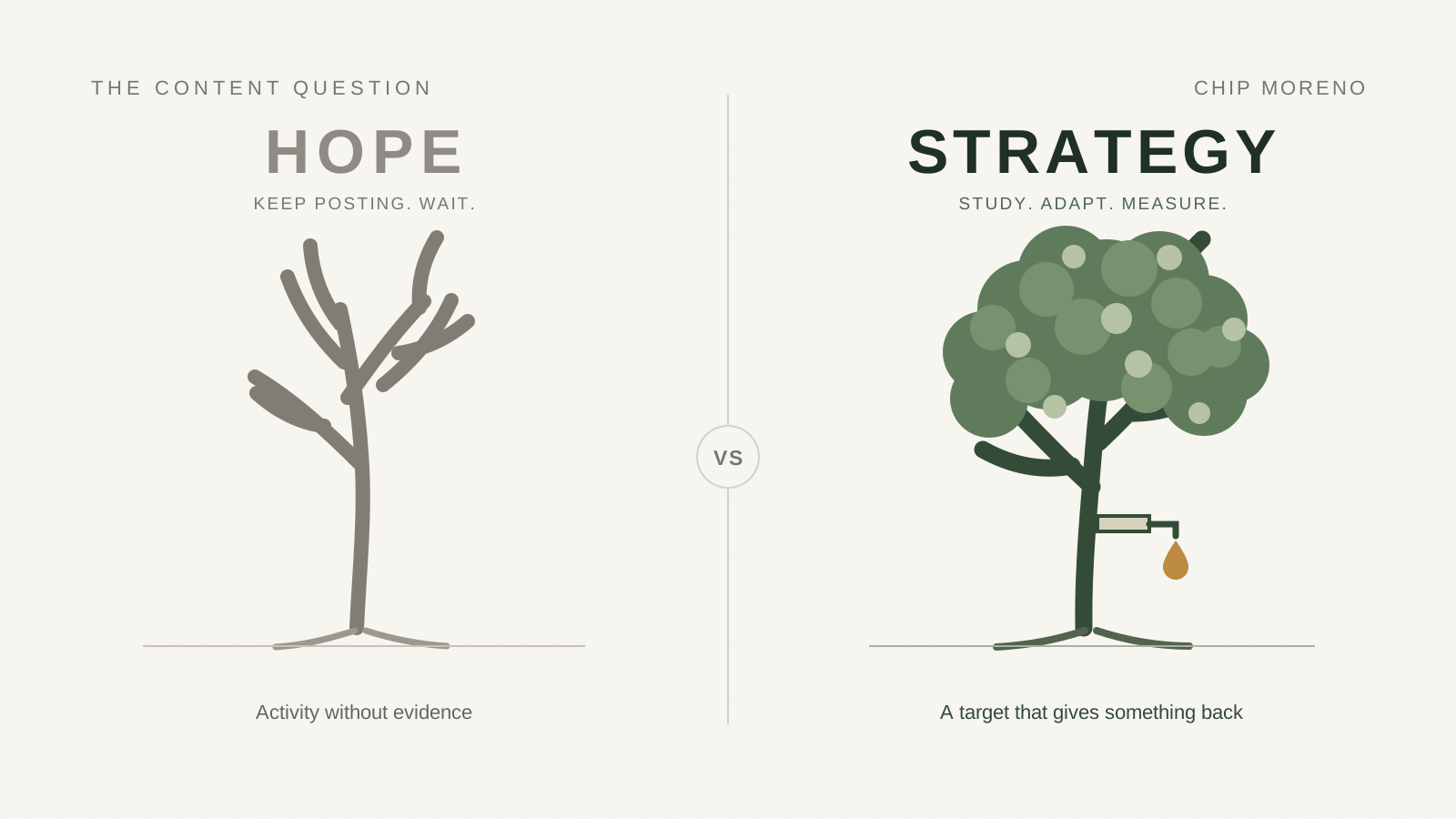
For months, I tapped a dry tree.
I posted videos. Wrote blogs. Sent newsletters. Published consistently, just like everyone advises. Some posts got decent views. Most got silence. And I kept telling myself the same thing everyone tells you: consistency compounds. Just keep showing up.
Then I asked myself a question that actually hurt:
Have I ever seriously studied the best content in my niche? Not skimmed it. Not admired it. Studied it — and tried to copy the mechanics?
The honest answer was no. I was publishing on vibes. I was hoping that something as banal as consistency would eventually turn into money.
It doesn't. You can tap a dry tree for months. It will never burst.
Consistency Is Not a Strategy
Here's the part nobody says out loud: consistency on bad content is just organized invisibility.
You become a regular. Predictable. Part of the furniture. The algorithm learns to ignore you politely, and so does everyone else.
Watching your competitors isn't enough. Even studying them isn't enough. You have to imitate — sit down and rebuild their best post line by line, hook by hook, until the structure reveals itself. Why does the opening line grab? Where does the tension sit? What promise keeps you reading?
Almost nobody does this. Inspiration is easy; converting it into action is rare. That gap between admiring good work and reverse-engineering it is where most creators quietly disappear.
And here's the counterintuitive part: when you actually attempt to copy someone good, you don't produce a copy. You produce a lesson. The mechanics transfer. The voice stays yours. By the time you finish rebuilding, you've made yourself better. Copying, done seriously, is just accelerated learning wearing a disguise.
The 5PM Lie
While I'm confessing, here's another one.
When I started as an entrepreneur abroad, I had a rule in my head: work hard all day, and at 5 PM you've earned your evening. Especially living overseas — the night markets, the cities, the views. I put in the hours. I deserve this.
Feels healthy. It's a lie.
Working all day means nothing. Hours are a currency with no exchange rate. You can be busy for ten hours and produce nothing anyone would pay for. A lunch-spinner's day.
The only question that matters at 5 PM is: what outcome did today produce?
Not tasks completed. Not emails answered. Not "I was productive." Outcome — a lead, a sale, a shipped asset, a skill that compounds.
Asking that question is painful, because outcomes are never guaranteed and never fully mastered. They're partly luck. You don't control the result; you only control your output.
But — and this is the paradox of entrepreneurship — you can't be satisfied with output alone. Nobody pays for "my best." They pay for results. Fall short consistently, and the market doesn't comfort you. It replaces you.
So no, you don't get to feel accomplished at 5 PM because you were busy. Rest is earned by results, not exhaustion. I still enjoy the cities I live in. But the question comes first now. Then the evening is actually free.
Fear Is Table Stakes
One more hard-won note, since it changed how I write everything.
Showing people what happens if they don't work with you — the penalties, the missed money, the slow bleed — that's not aggressive marketing. That's the minimum viable message. Table stakes. The entry fee.
If your content doesn't make the reader feel the cost of inaction, you haven't advertised anything. You've just narrated.
The Small Player's Unfair Advantage
The big creators in your niche have more to lose than you. Reputation, sponsors, a persona to protect. They publish carefully.
You have nothing to lose. You can swing wild, take angles they can't, say the thing they're hedging around. That willingness to risk is the one asset they can't buy back once they've grown.
Use it while you have it.
What I Actually Changed
In case it's useful, here's the shift from theory to practice:
- Pick the top 10 posts in your niche. The ones with obvious traction. Break down why each one works — hook, structure, stakes, payoff.
- Rebuild one line by line with your own story and your own market. Publish it. Repeat weekly.
- Grade every post on outcomes, not effort. Did it produce views that turned into clicks, replies, leads? If not, the tree was dry. Move to a different tree.
- Make fear of inaction explicit in anything you're selling. Gently, but explicitly.
The Point
Effort is not the strategy. Consistency is not the strategy. Choosing the right tree is the strategy — and then hitting it hard, with everything you've learned from the people already getting sap.
You control your output. You don't control outcomes. Hold both truths, refuse the comfort of "I did my best," and keep walking until you're standing at a tree that actually flows.
Then tap.
I apply this to my own business the only way I know how — by writing about the tax problems Americans abroad actually get punished for ignoring. If that's you, check out FileAbroad.